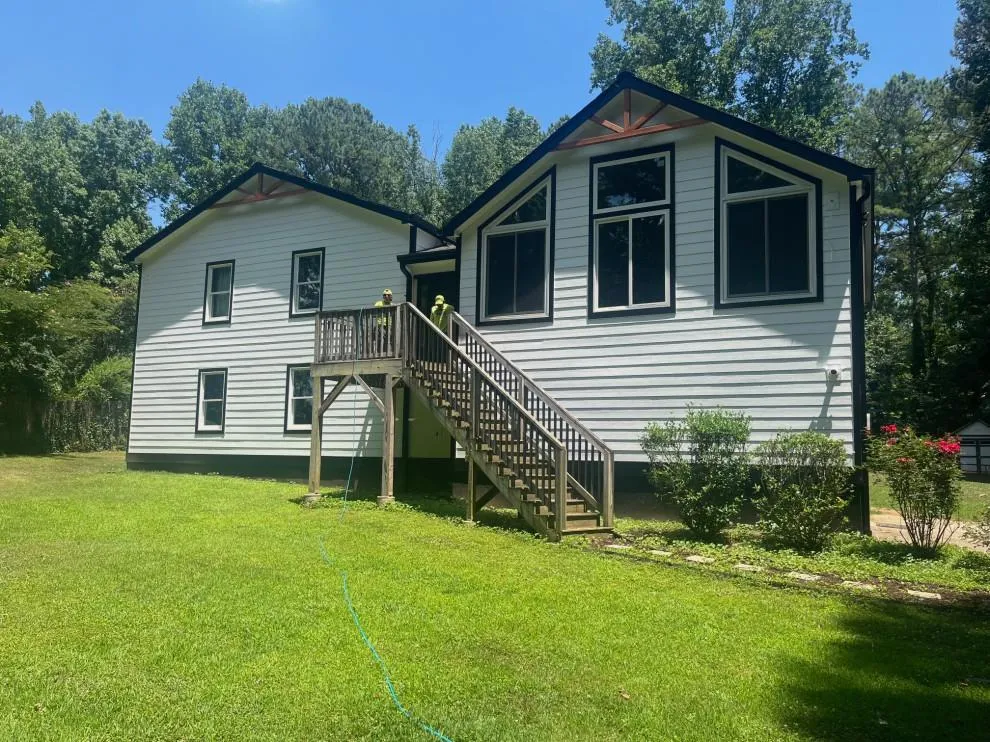
If you have admired the crisp vertical lines of a modern farmhouse driving through Milton or Alpharetta, you have been looking at board and batten. It is one of the most requested exterior styles in North Atlanta right now, and for good reason: it adds height, texture and a distinctly current character that reads as both timeless and fresh. This guide covers what board and batten actually is, how James Hardie builds it in fiber cement, what it costs, and how to get the proportions right on your home.
Board and batten is a vertical siding style with roots in early American barn construction. Wide boards are installed edge to edge, and narrow strips called battens are placed over the seams between them. The result is a strong vertical rhythm of raised lines and shadow that draws the eye upward and gives a wall real depth. Once purely rural, the style has become a staple of farmhouses, craftsman homes, modern builds, and accent applications on gables and entryways.
In fiber cement, the look is built from two products working together. Hardie Panel vertical siding forms the wide field, and Hardie Trim batten boards are applied over the seams to create the signature vertical lines. The narrowest batten option is about 2.5 inches wide, and because it is fiber cement, it carries the same engineering that makes Hardie resistant to high winds, sun and moisture. You can read the manufacturer’s overview in the James Hardie
guide to board and batten siding.
Field panel Hardie Panel vertical siding forms the wide vertical boards.
Battens Hardie Trim batten boards cover the seams; narrowest is ~2.5″.
Material Fiber cement — resists moisture, rot, pests and warping in Georgia’s climate.
Best styles Modern farmhouse, Tudor, craftsman, and gable or entry accents.
Curious how board & batten would look on your home? We’ll show you options and quote it in writing. Get my free quote
Getting quotes for your home?
We respond within 24 hours. No high-pressure sales.
Expect board and batten to run higher than standard lap siding. James Hardie installations generally fall in the range of roughly $10 to $15 per square foot installed, with most full replacements landing between $20,000 and $30,000 for an average home — and board and batten typically sits toward the upper end of a comparable project. The reason is straightforward: the style uses more material (the panels plus all those battens) and more labor to lay out and install the vertical pattern cleanly. As always, the real number comes from a written, itemized estimate for your specific home; our
Marietta cost guide breaks down the variables.
You do not have to wrap the whole house to get the effect. Board and batten shines in three common applications: as a full-facade treatment on a modern farmhouse where the vertical lines define the whole look; as a gable or upper-story accent that adds interest above lap siding; and as a feature wall on an entry or a prominent elevation. Mixing board and batten with lap siding is also one of the biggest exterior trends right now, giving a home texture and contrast while keeping the budget in check.
Not sure whether to go full board & batten or use it as an accent? Let’s look at your elevations together. Talk to a specialist
The difference between board and batten that looks custom and board and batten that looks off is almost always in the proportions. Batten spacing sets the whole character: wider spacing between battens reads more modern and airy, while tighter spacing feels more traditional and detailed. The width of the battens themselves, the trim around windows and corners, and the color and contrast all interact. This is where an experienced installer earns their keep — mocking up spacing options and getting the layout balanced across each elevation before a single board goes up.
Both are excellent in fiber cement, so the choice is about the look you want and the budget you have. Lap siding — horizontal boards — is the traditional, widely loved default; it suits almost any architecture, installs a bit faster, and generally costs less. Board and batten makes a stronger, more distinctive statement with its vertical lines, and it is the defining feature of the modern farmhouse style so popular across North Atlanta right now — but it costs more in both material and labor.
For many homeowners, the best answer is not either-or. Using board and batten on the gables, the entry or a feature elevation while running lap siding across the rest gives you the distinctive vertical accent where it has the most impact, keeps the overall budget in check, and creates the layered, mixed-texture look that is itself a 2026 trend. An experienced installer can mock up where the transition should fall so it reads as intentional rather than arbitrary.
Bring the modern farmhouse look home. Get a written, itemized quote for James Hardie board and batten — with the layout planned for your elevations.
Get my free quote Call (678) 400-2012
Ready for Your Free Estimate?
Join 1,000+ happy Georgia homeowners. Professional measurement and detailed written proposal within 48 hours.